The original language
The Hebrew and Greek beneath every verse, Strong's numbers and Word study, the Passage Guide, Matthew Henry's commentary and the cross-references.
The Interlinear
Interlinear, in the reader's toolbar, sets the Hebrew of the Old Testament or the Greek of the New beneath the chapter, word by word. Each word shows its English gloss, the word itself, how it is spoken, its Strong's number and a short code for its grammar. Point at or focus a grammar code to read it in words.
It has three views:
- Forward: word by word, in the original's own order.
- Reverse: in the translation's order, each English word with the original word it renders.
- Inline: the whole chapter as running text, with the same details to each word.
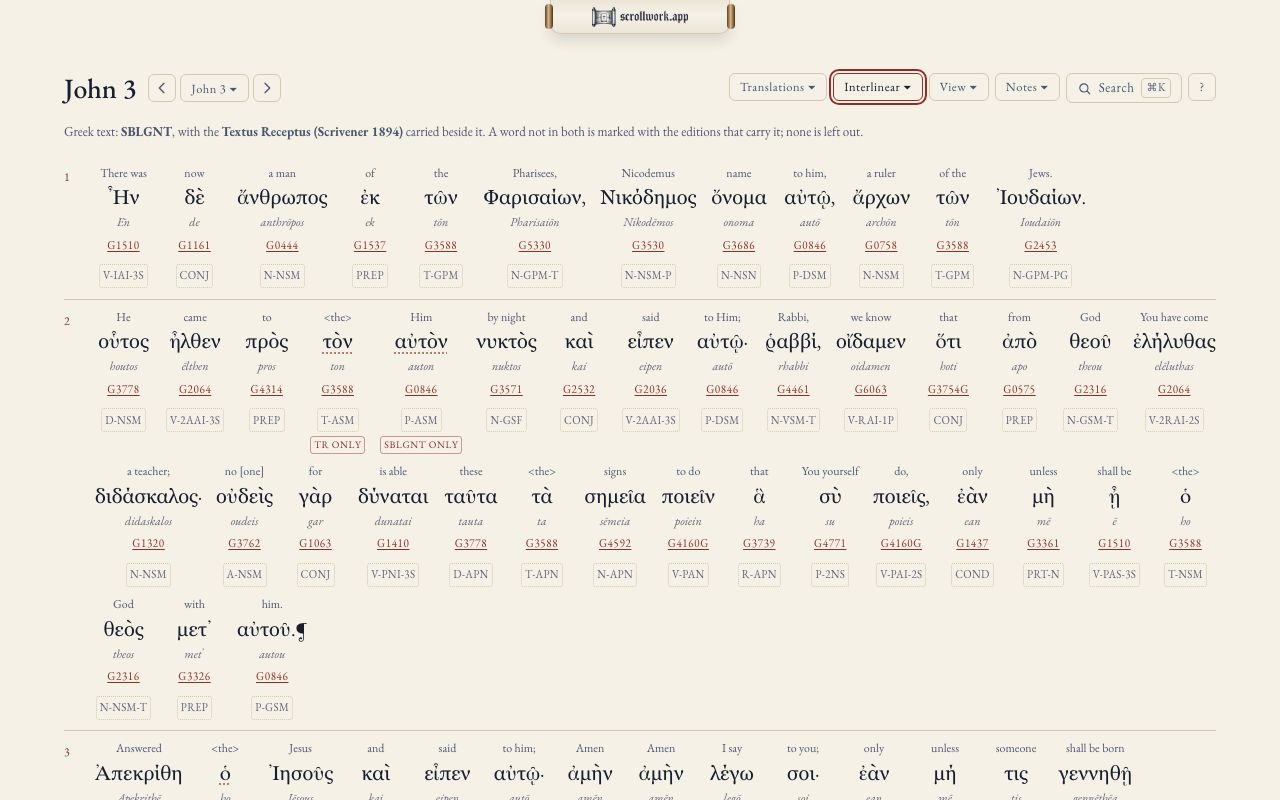
The Greek is the SBL Greek New Testament, with the Textus Receptus carried beside it: a word that is in one and not the other is marked with the edition that has it, and none is left out. The Hebrew is the Westminster Leningrad Codex. The words, glosses and grammar come from STEPBible (Tyndale House, Cambridge).
While the Interlinear is open, translations side by side wait until it is closed.
The original language as text
The original texts are in the translation pickers too, after the translations: Original language (the Hebrew in the Old Testament, the Greek in the New), Hebrew (Westminster Leningrad Codex), Greek (SBLGNT) and Greek (Textus Receptus). Read one alone, or beside a translation. Hebrew reads right to left, with every vowel point and accent. Click a word to open its Word study.
Strong's numbers
The King James Version is tagged word by word with Strong's numbers.
- Point at a word in a King James column and its number shows.
- Strong's, under View, shows every number in gold at once.
- Click a word and choose Concordance to see where else it stands.
Word study
A Strong's number opens Word study: the word, how it is spoken, its definition from Strong's dictionary (1890), how the King James renders it, and STEPBible's brief lexicon entry. Below is every place it occurs, grouped by book, each opening a small reader; and Along the timeline, where in the Bible's history it is used.
The Study menu
Click or tap a verse's text (or press Enter on a focused verse) for the Study menu:
- Passage Guide: everything about the verse in one place, below.
- Interlinear: the verse word by word.
- Concordance: on a King James word, every place its Strong's number stands.
- Bible Comparison: the verse in other translations, or Add a translation as a column.
- Cross-references: the verses that speak to this one.
- Copy to Clipboard and Share Verse.
- On the scrolls: the people, places and events the verse names, and Art of this passage.
The Passage Guide
The Passage Guide opens beside the text as a sheet headed with the verse. It gathers:
- Cross-references.
- Matthew Henry: his comment on the passage.
- People, places and events the verse names, each leading to the scrolls.
- On Biblical Art: the works that depict it.
- Your notes and highlights on it.
Open beside the text keeps it open as you read on; Open in a new tab opens it as a page of its own.
Commentary
The commentary is Matthew Henry's Commentary on the Whole Bible (1706), marked as a classic Protestant commentary of the English Presbyterian tradition. Where the usual text has a gap, it is filled from the 1828 Philadelphia edition, and labelled so. Where the source's own text of a comment is cut short, the reader says so rather than filling it in.
Cross-references
Cross-references come from two sources: OpenBible.info, each with the number of readers who voted it useful, and the Treasury of Scripture Knowledge, with the words each one covers. The first ten are shown, then Show more. After a verse's own references come those from other verses that refer to it.
For every cross-reference in the Bible drawn at once, see the Cross-references chart in The charts.
Art
Where a verse is depicted on Biblical Art, Art of this passage opens it in the reader's own viewer, with Open it on Biblical Art's road to see it among the rest. See The scrolls.