The scrolls
The Lineage of Jesus Christ, The Story in Gold, Biblical Art and the Megiddo Mosaic, and how to move through each.
Four scrolls stand on the Bookshelf, under Scrolls, and in the menu's Scrolls column.
The Lineage of Jesus Christ
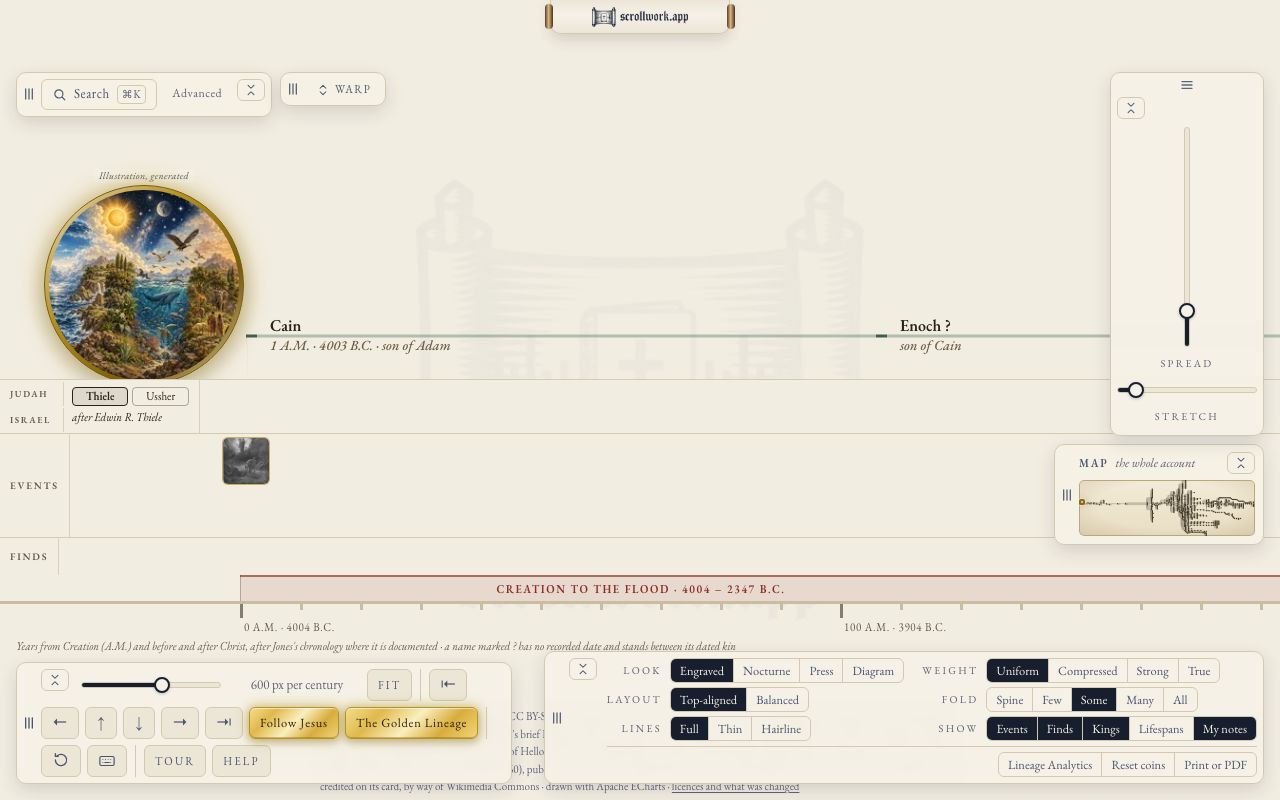
Every generation from Adam to Jesus, drawn as a river of descent on one long scroll laid out along time.
Moving around
- Drag to move. The wheel scrolls; Shift and the wheel scroll sideways; Ctrl and the wheel, or a pinch, zoom.
- The zoom slider, with the scale beside it in pixels per century, and Fit to see the whole account.
- The arrow buttons move half a screen; Start and End go to either end.
- Follow Jesus brings you to Him, wherever you are; The Golden Lineage shows only the direct line from Adam to Jesus, in gold.
- Reset the scroll puts everything back as it was.
- Keyboard shortcuts lists every key; see Keyboard shortcuts.
The scroll's tools
The tools stand in small panels you can drag by their grip and fold away; each remembers its place.
- Search: see Search.
- Warp: an era, or a span of years, alone. Choose an era and Go, or set the years and Warp to these years. Return to the whole account comes back; Share link copies an address that opens the same view.
- Spread and Stretch: more room between the lines, and between the years.
- Map: a small picture of the whole account, with your view marked on it. Drag the mark, or use the arrow keys on it, to move.
This scroll's controls
The settings panel holds Look (Engraved, Nocturne, Press, Diagram), Weight (how each line of descent is drawn), Layout and Fold (how the lines stand and how many people are drawn), Lines (how fine), and Show: Events, Finds, Kings, Lifespans and My notes. Its actions are Lineage Analytics, Reset coins and Print or PDF (see Printing and PDF).
People, cards and the Drawer
- Point at a name (tap it on a touch screen) for a card: dates, chronology and how many verses name them, with More info.
- More info opens the Drawer: the name in its original Hebrew or Greek, the dates, the first and last verse, and the tabs At a glance, Faith, Evidence, History and Integrity. See Faith, Evidence and History.
- Add to comparison sets up to four people side by side; Show the comparison opens them.
- Every verse is a link that opens a small reader, with Open in the full reader.
- The Drawer opens from the bottom, the right or the left, as set on your account page.
Eras, lanes and coins
- Twelve eras run along the ruler. The era at the centre of the screen is announced; an era's name opens its card, with Frame this era.
- Above the ruler, lanes hold related events and people, the finds of archaeology, and the kings' reigns, with a Thiele and Ussher switch for the kings' chronology.
- The gold coins open Scripture's great moments, each a story of its own, from In the beginning to The Holy Spirit. Back to the scroll returns. Drag a coin out of the way if it covers something; Reset coins puts them back.
The welcome, the tour and Help
The first time you open the lineage on a device, a welcome offers a few quick tips, Take the tour and a link to this Help. The tour visits each toolbar and the scroll's main parts, one step at a time, with Back, Next and Close. Tour and Help stay in the main toolbar to open again.
On a phone
On a narrow screen the lineage becomes a list: Find a person, an Era picker, the people era by era, and the gold coins at the top. Tap a person to open the Drawer.
The Story in Gold
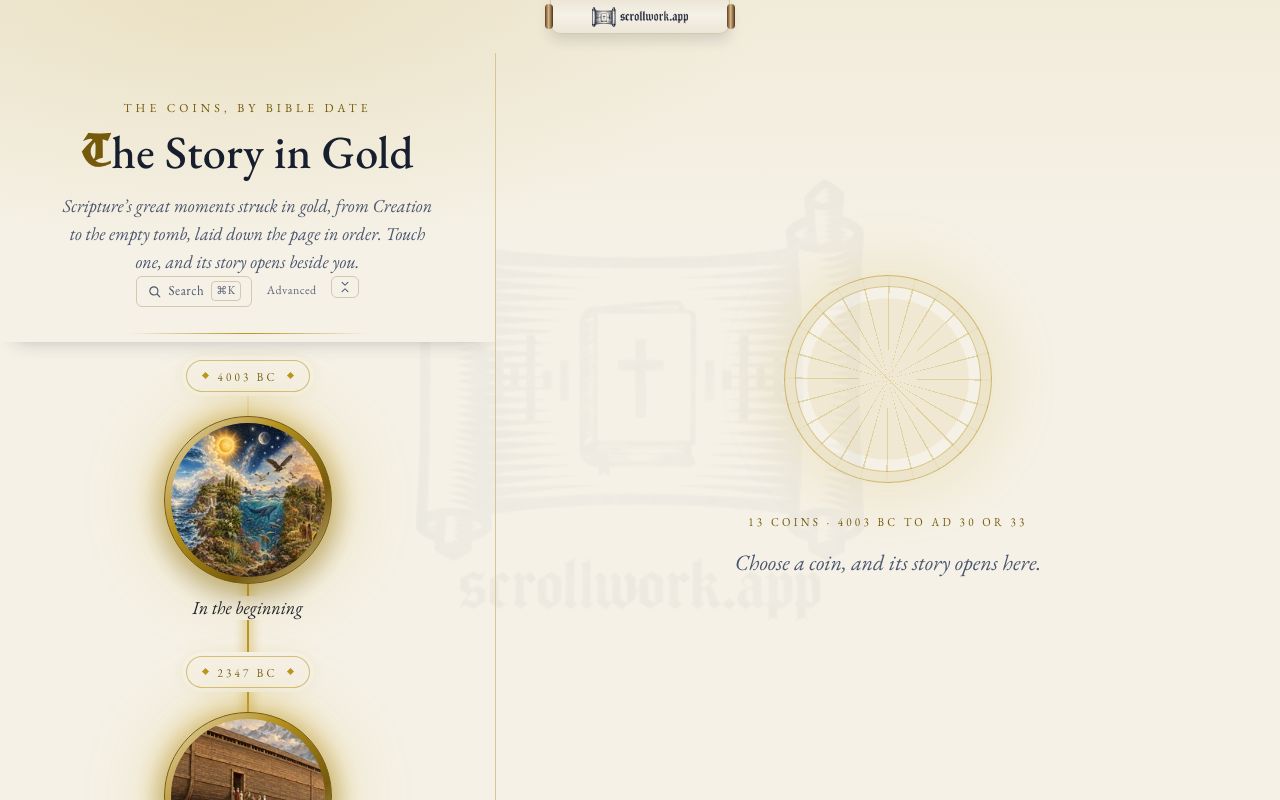
Scripture's great moments struck in gold, from Creation to the empty tomb, set down the page in order: thirteen coins on a gold thread, earliest first. Touch one and its story opens beside you (on a phone, as a sheet). Close or Esc closes it. Each story has its own address, to share or come back to.
A date marked c. is taken from the passage's place in the corpus's chronology rather than from a recorded date, and the page says so.
Biblical Art
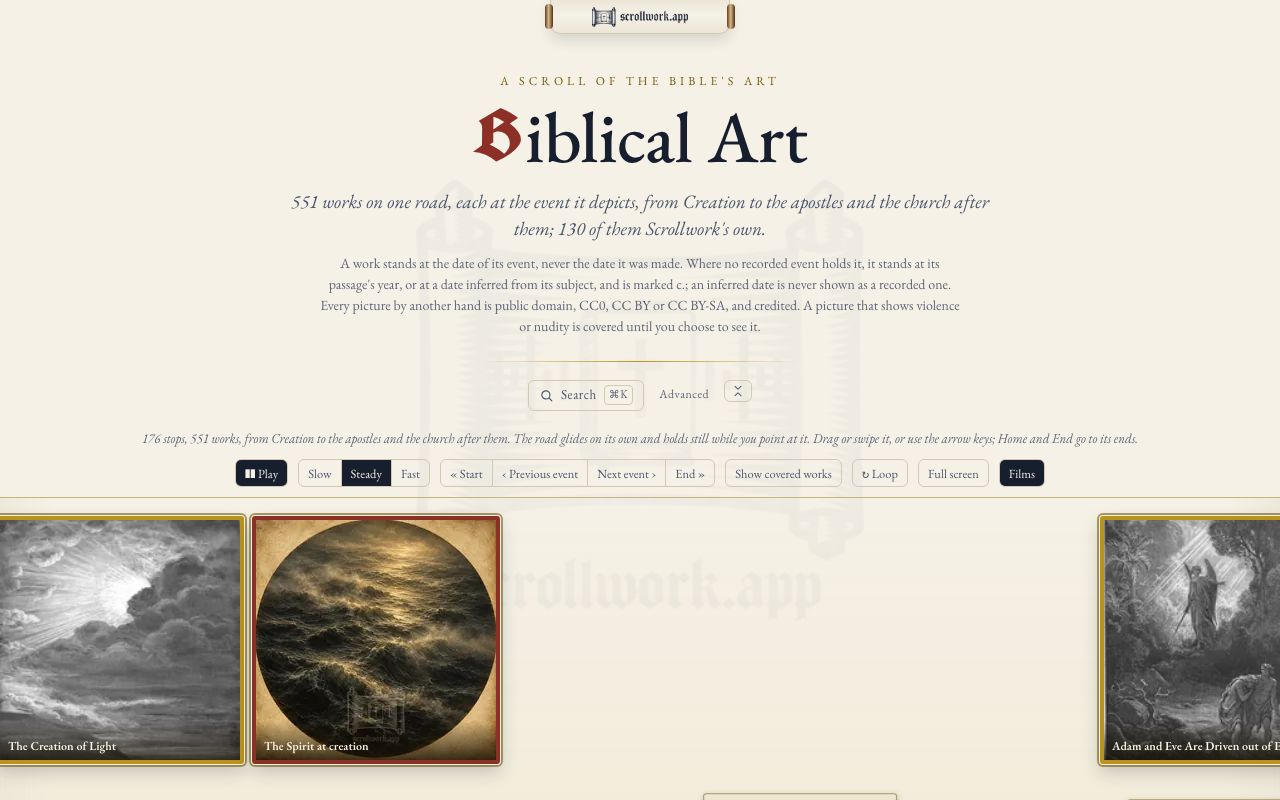
Every artwork Scrollwork shows, on one road from Creation to the apostles and the church after them. Each work stands at the event it depicts, never at the date it was made. Where no recorded event holds a work, it stands at its passage's year, or at a date inferred from its subject, marked c. and never shown as a recorded date.
The road glides on its own, slowly, and holds still while you point at it. Its controls:
- Play, or pause, and the speed: Slow, Steady, Fast.
- « Start, ‹ Previous event, Next event ›, End ».
- Show covered works: a picture that shows violence or nudity is covered until you choose to see it. This shows them all; Cover them again covers them. The page always opens with them covered.
- Loop: off at first. With it on, the road runs back to Creation at its end and glides on.
- Full screen: only the road and the art. Move the mouse or touch the screen to bring the controls back; Esc leaves.
- Films: takes Scrollwork's films off the road, or puts them back. A film plays silently while it is on screen (on a phone, or when you ask for less motion, it shows a still picture with a play button); click it to watch it full size, with sound.
Click a work for its card: its date and event, title, artist, credit and licence, How it is dated where it is marked c., and links to its event on the lineage and to its source. ‹ Before and After › step along the road. Click the picture to see it full size.
The Megiddo Mosaic
The church floor at Kefar 'Othnay, near Megiddo, laid about AD 230: a written history with pictures, in six parts, from the place beside the Roman legion to where the mosaic is now. Each of its three inscriptions is shown with its Greek and translations, numbered at each part. Where scholars disagree, the positions are set out earliest first, with no verdict; each part ends with its sources.